
more Mainstream Apologetics ...

Evidence ID: BIB-EV73
Evidence: Gospel of Mark
Summary: Based on biblical scholarship, the Gospel of Mark is credited to Mark by Papias of Hierapolis in 110 AD. Mark was the associate of Peter and Paul, and the scribe of Peter one of the twelve disciples. Because of the mentorship of eyewitnesses Peter and Paul, Mark presents a trustworthy account of the life and ministry of Jesus.
Description: The Gospel of Mark is a record of Jesus' life and ministry as seen through the eyes of Peter. It is inscribed by Mark the close companion of Peter.
According to the Apostolic Father Papias of Hierapolis (ca. 60-130 AD) [REF-PAP01] and other church Fathers, the gospel was written by the apostle Mark, or sometimes referred to as John Mark.
"This also the presbyter (Papias) said: Mark, having become the interpreter of Peter, wrote down accurately, though not in order, whatsoever he remembered of the things said or done by Christ. For he neither heard the Lord nor followed him, but afterward, as I said, he followed Peter, who adapted his teaching to the needs of his hearers, but with no intention of giving a connected account of the Lord’s discourses, so that Mark committed no error while he thus wrote some things as he remembered them. For he was careful of one thing, not to omit any of the things which he had heard, and not to state any of them falsely." These things are related by Papias concerning Mark. PAPIAS OF HIERAPOLIS, Writings of Eusebius Pamphilius, Church History 3.39. vv15 [REF-EUS04]
Because of Paul's strong disagreement with Mark (Acts 15:36-41), Papias would not have attributed this gospel to Mark unless he was confident and had factual information.
Based on the Book of Acts, Mark was the son of Mary (Acts 12:12) and the cousin of Barnabas (Colossians 4:10). Some scholars suggest that because Christians often met at Mary's house, the upper room of her house may have been the location of the Last Supper. If this were the case, Mark may have had encounters with Jesus making him an eyewitness. Mark was a close associate of Peter who was an eyewitness of the life and ministry of Jesus.
Mark was not an eyewitness of the events of Jesus' life and ministry. Rather he relied on Peter the disciple of Jesus who was an eyewitness of Jesus' life and ministry. According to tradition, after Paul's death in around 69 AD, the church asked Mark to put in writing the oral teachings of Peter. Mark served Peter as a scribe to organize and record the sayings of Jesus. Mark sat under Peter's teaching for several years and heard many of the sayings retold (Acts 10:34-43). In 2 Peter 1:16, Peter states that "we (the disciples) were eyewitnesses of his majesty". Therefore, Mark's writings are based on the eyewitness account of Peter.
According to J. Warner Wallace [REF-JWW01], the authorship of the Gospel of Mark can be examined using forensic analysis to better determine to what extent Peter was the source. Wallace carefully studied Mark's gospel and noticed that Mark referred to Peter prominently, frequently, and with familiarity and respect. Mark included details in his Gospel that could only be attributed to Peter. Additionally, the overall outline of Mark's Gospel, followed the preaching style used by Peter (Acts 1:21-22, Acts 10:34-43).
The Gospel of Mark was probably written sometime between 50-70 AD. Because of the similarities among the synoptic gospels, many believe that Mark's gospel influenced the writers of the Gospels of Matthew and Luke. If this were the case, then Mark's gospel would have been written in the early 50's AD. The Gospel of Mark was written within the lifetime of many Jews who would have also witnessed the same events.
The Gospel of Mark, as with other gospel authors, was composed of Jesus' sayings and accounts collected by the author for many years prior to the original manuscripts. The original autograph of the Gospel of Mark has not been discovered. The earliest copied fragments of the Gospel of Mark, Papyrus 45, dated from as early as late 2nd or early 3rd century (200–250 AD). Papyrus 45, known as the P. Chester Beatty, contains fragments of Mark chapters 4-9 and 11-12. The earliest complete manuscripts of the Gospel date from the 4th century. These complete manuscripts are known as Codex Vaticanus [REF-CXV01] and Codex Sinaiticus [REF-CXS01] [REF-CXS02].
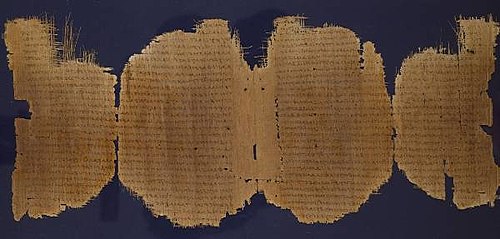
In 2012, Daniel Wallace a world-renowned paleographer from Dallas Theological Seminary announced that seven New Testament papyri were discovered, one containing portions of the Gospel of Mark [REF-CTM01]. This new fragment could predate P45 by 100 to 150 years, almost certainly placing it in the first century and making it the oldest of its kind. This fragment is still under investigation. [REF-DBW02]
The evidence presented regarding the eyewitness testimony of Peter as recorded by Mark attests to the trustworthiness of the record concerning Jesus' life and ministry.
Resources:
Copyright@2026 Mainstream Apologetics